
Policy Breakdown
The Federal Budget
The federal budget is how much money the government spends and takes in each year. It includes trillions of dollars for vital programs and services, as well as projected tax revenue. Check out this primer to learn how it works, the challenges it faces, and ideas for improving it.

WHAT IS THE FEDERAL BUDGET?
What’s one thing you and the federal government have in common?
You both have a budget.
Your budget is based on how much money you make and how much you’ll spend on things like groceries, rent, and matcha lattes.
The federal budget, on the other hand, is the culmination of policy decisions we’ve made about taxes, programs, and services. Think of it as a big financial roadmap that shows you where the government’s money comes from and where it goes.
Origin
Our federal budget story begins in 1789 with the Taxing Clause and the Appropriations Clause in Article 1 of the Constitution, which gave Congress control over how the federal government collects and spends money. That’s why people often say that Congress has “the power of the purse.”

REVENUE
Over the years, the United States has relied on different forms of revenue to fund the government.
From the founding to the Civil War, 90% of revenue was generated by tariffs, or taxes on imported goods. Tariffs continued to provide around half of our revenue through the late 1800s and early 1900s.
In 1913, the states ratified the Sixteenth Amendment, which gave Congress the power to tax personal income. Congress, in turn, passed legislation that lowered tariffs and established a federal income tax.
By 1920, individual income taxes had replaced tariffs as the government’s primary source of revenue.
Today, the federal government’s single greatest source of revenue is taxes on individuals — like you!
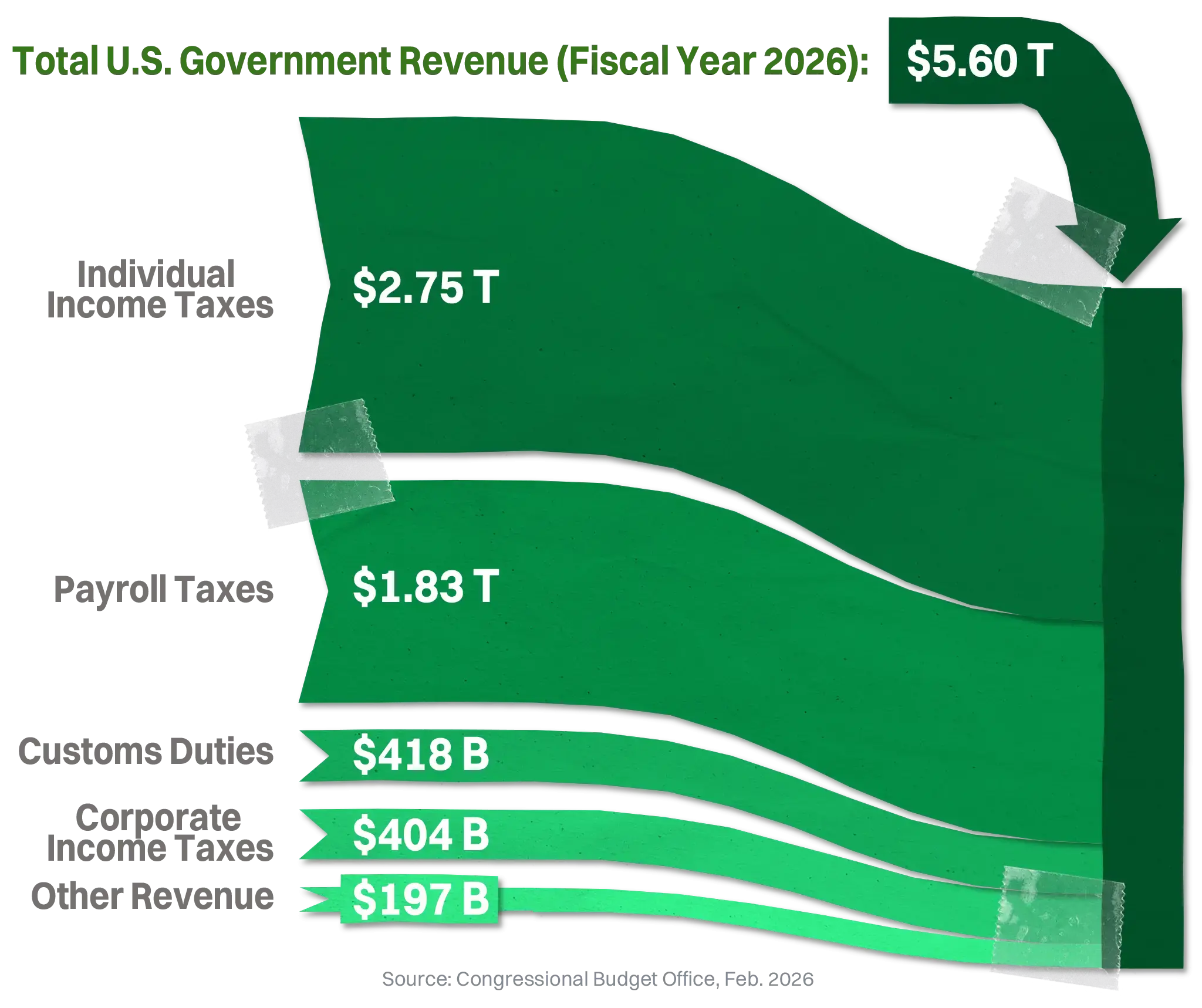
If you get a paycheck and file your taxes every year, then you’re likely already familiar with…
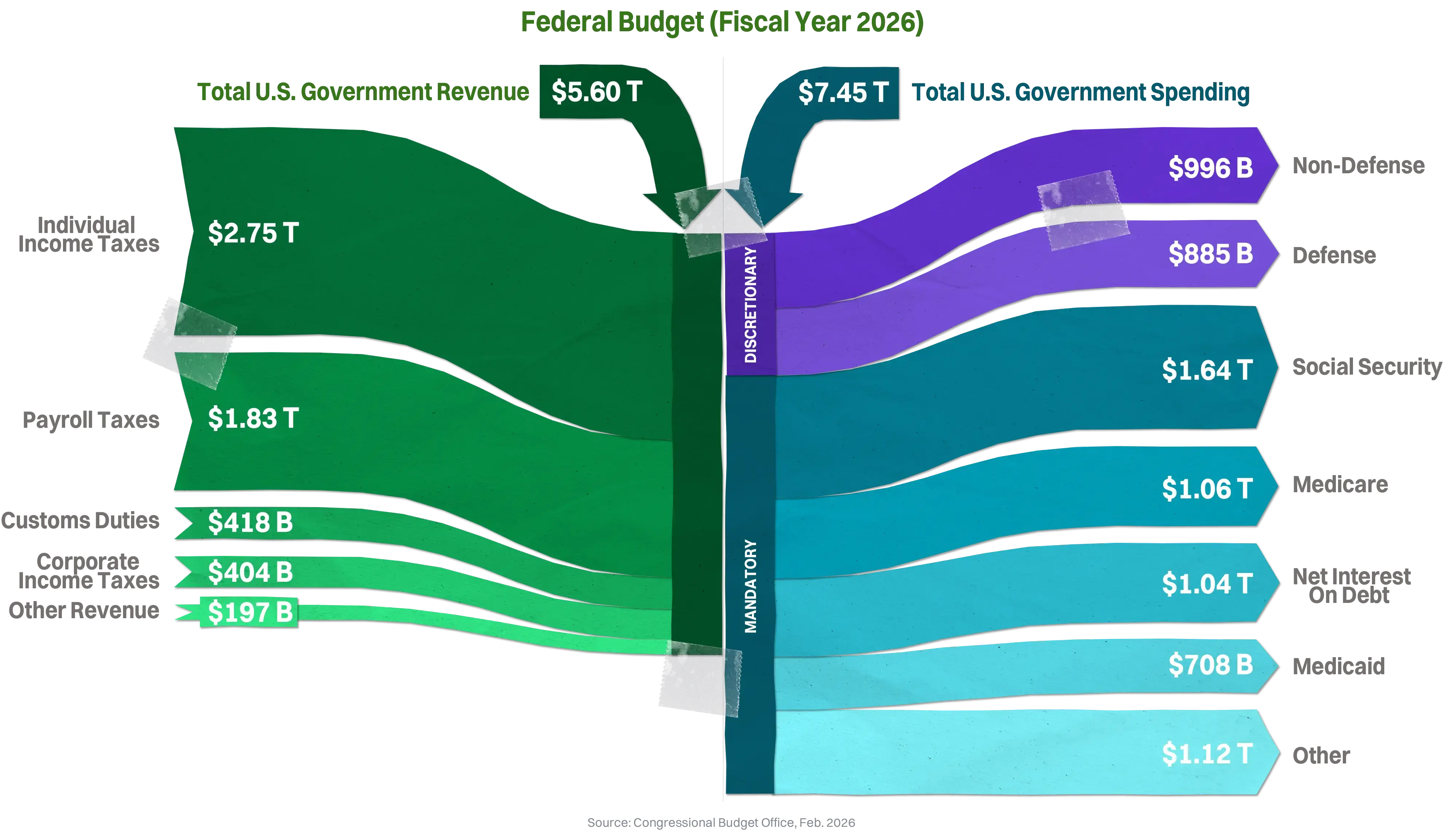
Levied on your yearly wages, salaries, or income, these taxes fund the general operations of the government. Think: infrastructure, disaster relief, defense, public transportation, and the interest on our national debt.
Payroll taxes
Levied on your earnings, these taxes are dedicated to funding programs like Social Security and Medicare.

But you may be less familiar with these other sources of revenue:
Tariffs are levied on the importers of foreign goods. These taxes make up the majority of customs duties.
Corporate income taxes impose a flat tax on the annual profits of qualifying businesses.
Excise taxes* are levied on specific goods and services, including gasoline, alcohol, and tobacco products.
Estate and gift taxes* are levied on transfers of money or property.
Non-tax revenue* is generated by activities and fees that fall outside the scope of taxes, including:
- Entrance fees at national parks.
- The sale of government assets, like buildings and land.
- Earnings from investments through the Federal Reserve System.
* These three funding streams compose the “Other” section of the graph above.

So, now you know how the federal government generates revenue.
But how does it actually spend all that cash?
(Spoiler alert: very easily.)
SPENDING
In the federal budget, spending is broken down into two major categories: mandatory and discretionary.
Mandatory spending is automatically required by law to occur each year without any further action by Congress.
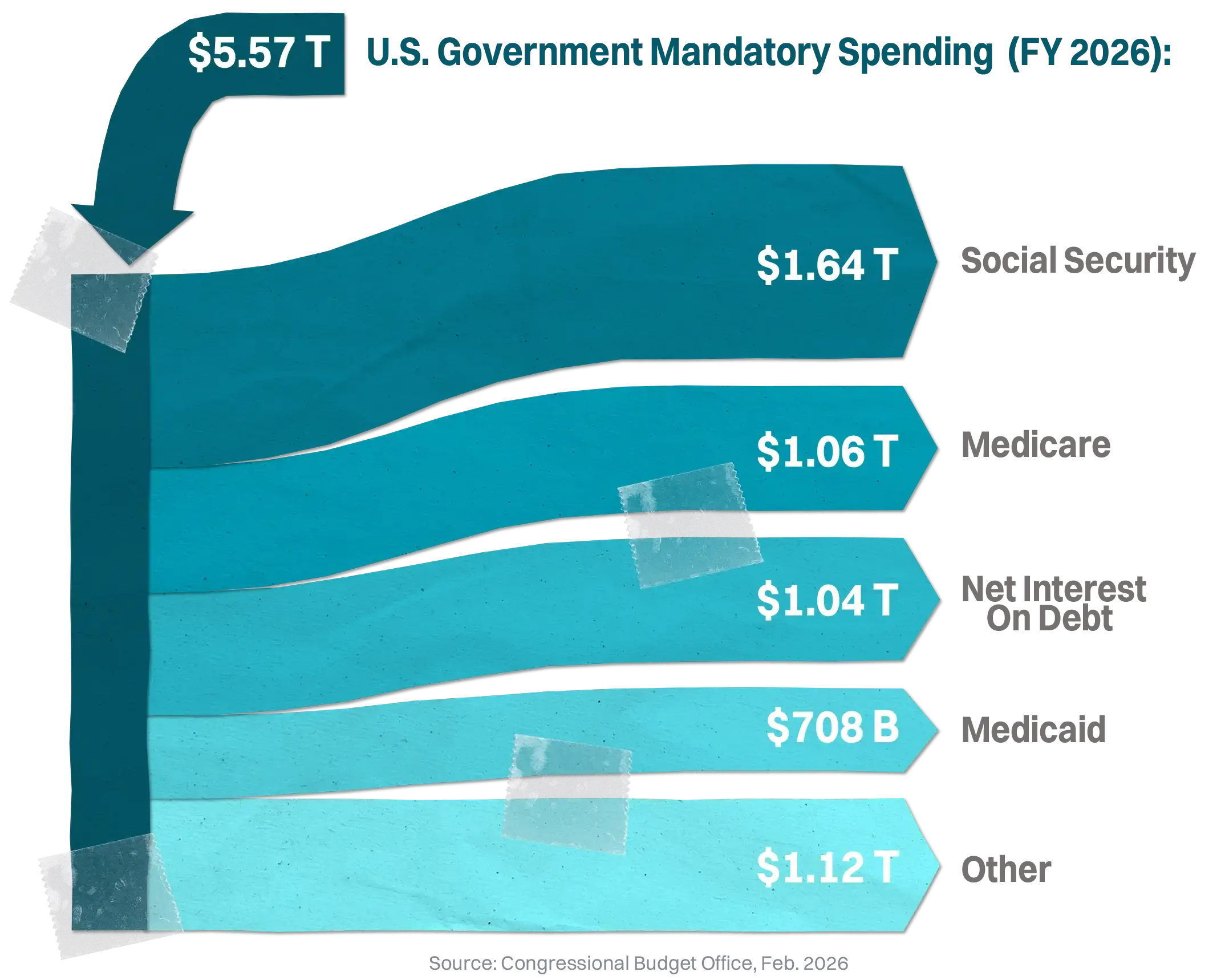
For programs that fall under mandatory spending, the law authorizing the program also determines the funding for it.
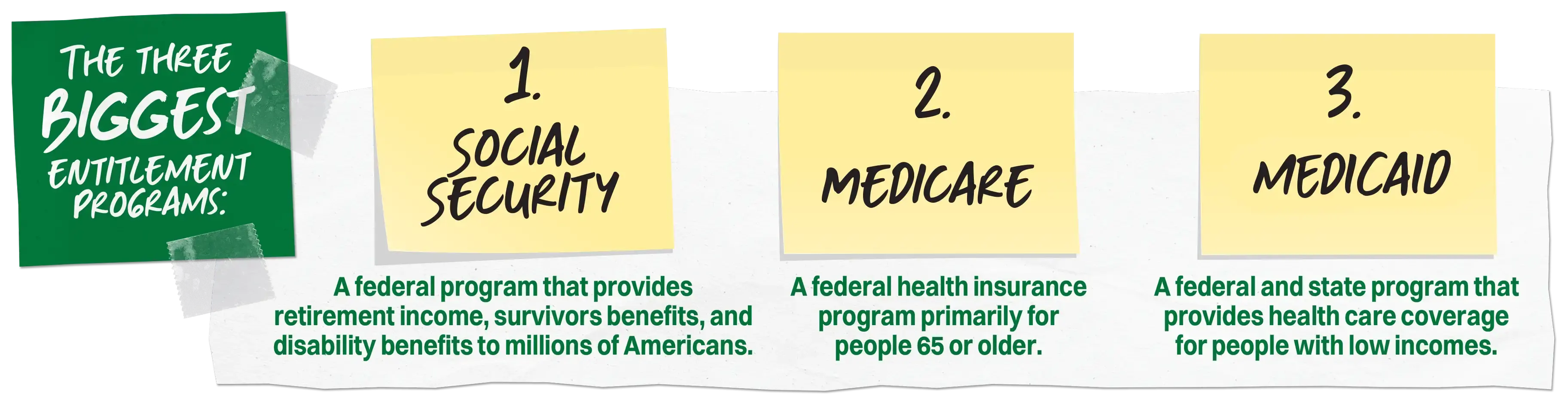
In most cases, the funding level for mandatory spending programs is determined by the eligibility criteria and benefit calculations included in the law that establishes them. Think: Social Security and Medicare. Spending for these programs isn’t determined annually by Congress, but by how many people qualify for their benefits in any given year.
In other cases, the law actually sets the specific level of funding — for example, grants to states for Temporary Assistance to Needy Families (TANF) have been set at $16.5 billion per year since 1996.
Social Security checks need to go out every month, and interest payments on our debt need to be made each year. That’s why Congress has essentially put spending for these items “on autopilot.”
Since we’re already obligated to fund it, mandatory spending is automatically included in the federal budget, and Congress doesn’t debate it during the annual budget and appropriations process.
The overwhelming majority of mandatory spending ends up in one of two places:
- Entitlement programs, which provide people with benefits once they meet specific eligibility requirements.
- Net interest payments, which cover the cost of servicing our more than $39 trillion national debt.
Discretionary spending, on the other hand, only occurs when Congress decides to spend that money for a given year.
These programs and priorities don’t have pre-set funding levels established by law. Instead, lawmakers debate and legislate these items every year to determine what should receive funding and how much to spend.
There are two types of discretionary spending: defense and non-defense.
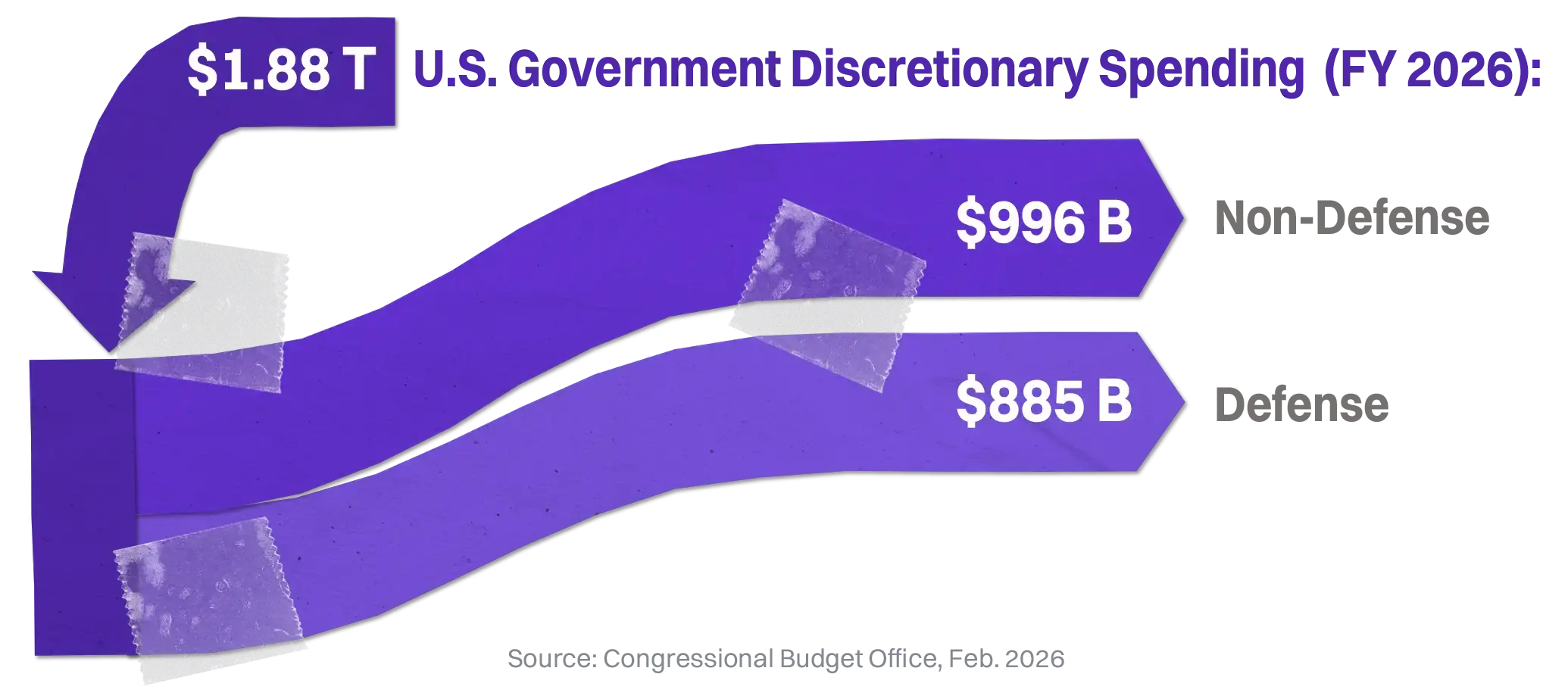
- Defense spending helps fund our military. It goes toward purchasing and maintaining equipment, training and paying service members, and research and development.
- Non-defense spending is a much broader category. It funds important programs in education, public health, scientific research, environmental protection, and more.
If you put together all of the revenue and spending for fiscal year (FY) 2026, the full federal budget looks like this.
Well, what happens if Congress spends more money than it takes in?
That’s what we call a federal deficit.
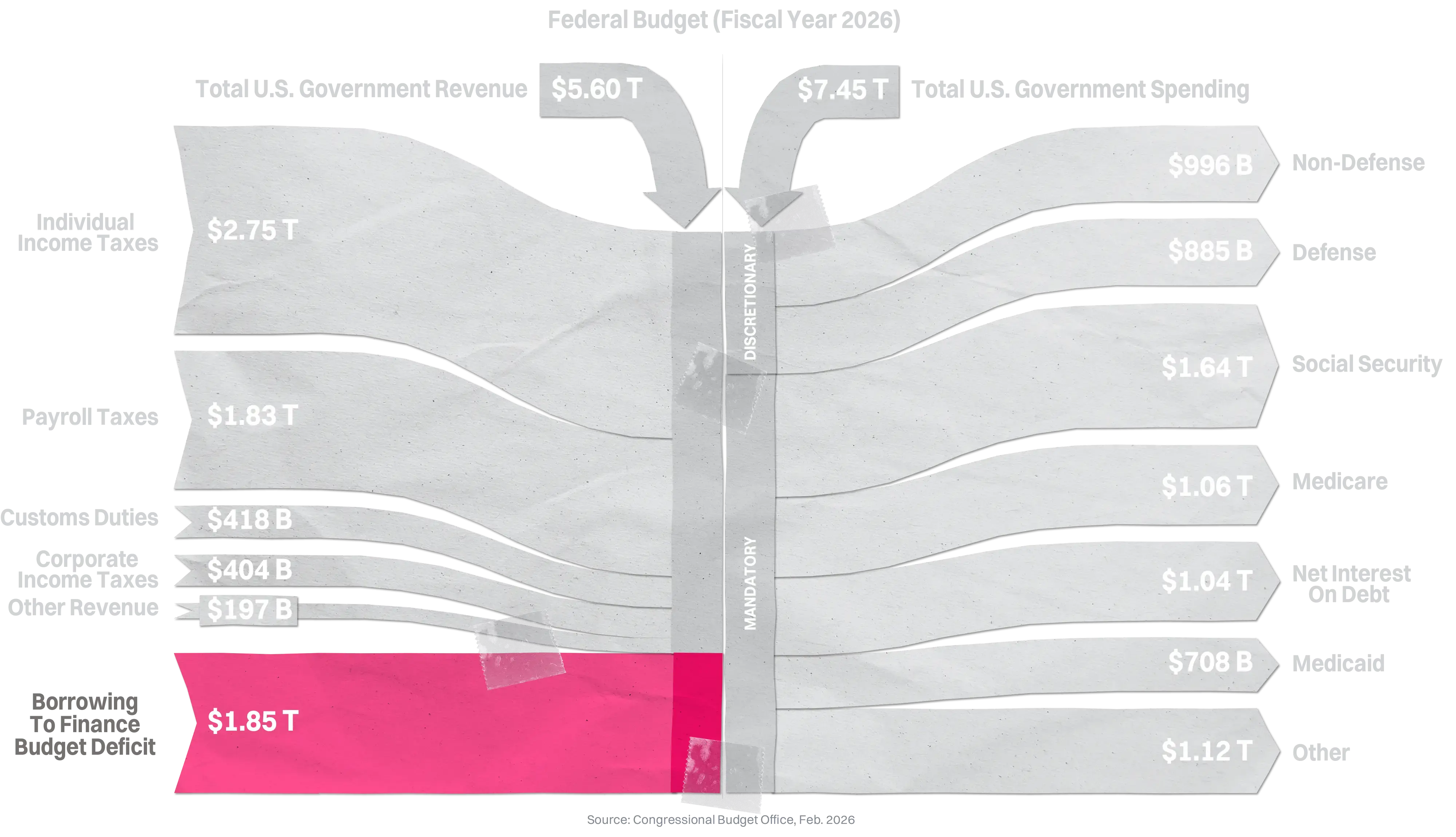
For every year we run a deficit, the government has to borrow to make up the difference, and the national debt grows. One day, it will have to pay that money back.
Today’s not that day. In 2026, we’re expected to spend $1.85 trillion more than we’ll take in, and the national debt is projected to reach $39.4 trillion.


.svg)

